I started my agentic development experiment from scratch, with a vanilla Claude Code: no skills, no plugins, no customization at all. My first two goals were quite clear: move them to the mini-PC and get agents to work nights.
Moving it to the mini-PC was a big change, interacting with my agents either from my laptop or while on the go with my phone. Without worrying about agents going to sleep when my device does. With the first goal achieved, it was time to tackle the next one: schedule the night runs. To get those to work, agents would need to be fully autonomous.
My workflow wasn’t there yet, I was still in the loop, giving the initial instructions like saying what to implement, triggering /simplify and /code-review. Asking to fix the review’s findings and what not until I was happy enough with the result to finally open a PR.
My first night run was a description of the workflow I was following:
Review the change, and fix what the review finds (up to 3 times)
Once the nightly prompt proved to be right I extracted it to a skill which I called /implement-a-bean. Meaning the nightly prompt was just calling that skill.
Surprisingly, the nightly run is not what had the most impact on my workflow — it was the skill. I’ve found myself transitioning from instructing agents to opening a few sessions, calling /implement-a-bean then move to something else and review the PRs afterwards. After a few days following the same repetitive behaviour the natural step was to remove myself out of the process. So I updated my Paseo schedule to run every 2 hours instead of 2 per night, putting a WIP limit to the amount of PRs open at any time. The actual prompt:
Count the open pull requests.
If five or more are open, do nothing. Finish, and archive the workspace.
If fewer than five are open, run the implement-a-bean skill.
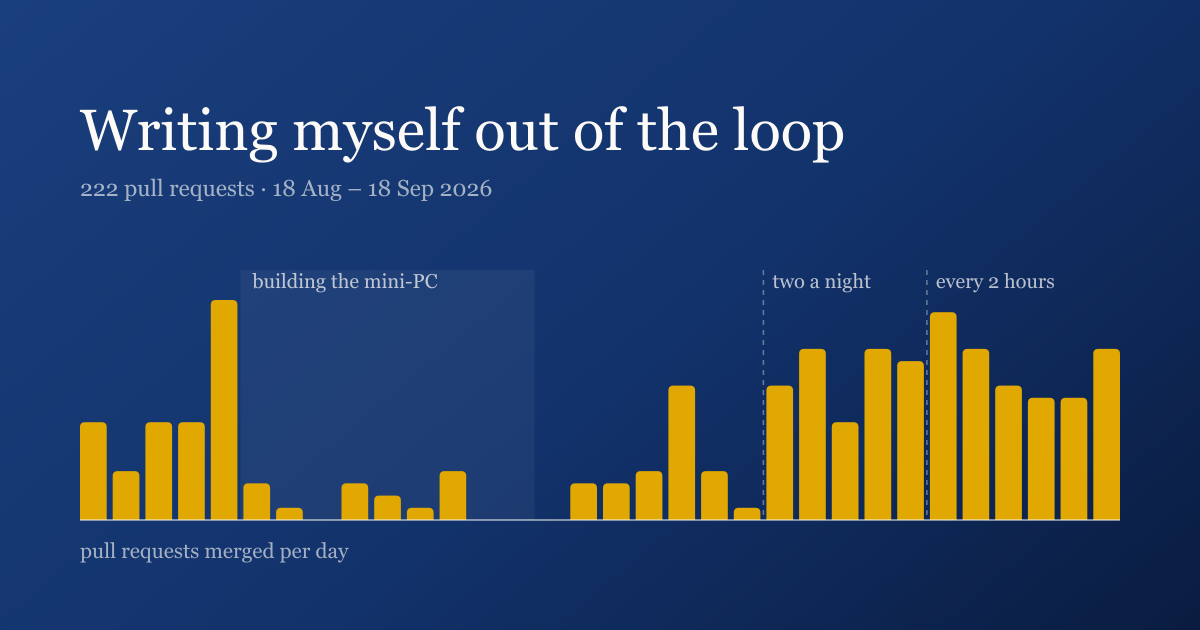
A nice chart is worth more than a thousand words:
Pull requests merged per day in personal-os. The shaded stretch is the move onto the mini-PC.
Before setting the mini-PC up is where I put most of the effort, thinking through edge cases and plumbing things up. When I started with 2 PRs per night I was also running /implement-a-bean throughout my day, it was a trigger and forget thing. Which explains the jump in the number of PRs per day. Finally, I switched to agents running every 2 hours.
It goes without saying that the scheduled agents result in shipping faster. Moving the bottleneck from build time to review time. Although if I’m being honest, I’m not reading the code on most of the PRs. I skim through the changed files looking for DB migrations otherwise I rely on the screenshots included on the PR description. One of the requirements for changes touching the UI is to include screenshots of the change. This allows me to gauge whether the implementation is what I wanted or not.
It wasn’t perfect from the get-go, while skimming through PRs I’ve observed that some of them were including more changes than originally planned. That was the agents going the extra mile: fixing related things or covering obscure edge cases. As a correction I created a rule so that one PR contains only one capability; everything else must be recorded as a follow-up bean. This had two consequences. It reduced the long tail of big PRs (+1k additions) from ~6% to 2%. At the same time the agents started to contribute to the backlog by adding tickets for tackling technical debt or improving the product around an edge case.
Share of pull requests that file a follow-up bean, averaged over 15 pull requests. The shaded stretch is before the bean workflow existed, so it is not comparable. The work did not stop being done — it stopped arriving in the diff.
All these changes had a visible impact on the output. Which were easy to measure: merged PRs, completed/created backlog items. But what about the small changes, like adding a paragraph to your AGENTS.md — what’s the impact of that in your pipeline? Can you measure it? Did the change move the needle in the right direction?
In a month I’ve built a web app to help me with the small recurring things that don’t deserve their own app.
It has lists (plain and todo), care and subscriptions management; and time tracking with light/dark theme, household sharing and multi-language support (en/es) without writing a single line of code. Yes, I did the initial DB modelling (but the AI implemented it) and made technical decisions at the boundary layer (how and where the app is deployed).
What’s the quality of the codebase? Does the code honour the defined architecture? Is it secure? Is the test suite any good?
As agents now write the code for me, my role in the project has changed. On the one hand I need to think at the product level, what features I want to include, what to prioritize, cleanup the backlog from dated items, etc. On the other, I act as a supervisor for my development pipeline, ensuring all the pieces work smoothly, reducing toil and removing friction so agents have the right context and tools to carry out their job.
Which brings many questions around what will become of our profession.